Can You Build Glutes in a Calorie Deficit? The Short Answer Is No
You eat clean. You have been eating clean for years. You hit your protein, you train hard, and your glutes look exactly like they did two years ago.
So you assume something is wrong with your training. It usually isn't. If you want to build glutes in a calorie deficit, you are asking your body to do two opposite things at the same time, and it will pick the one that costs less.
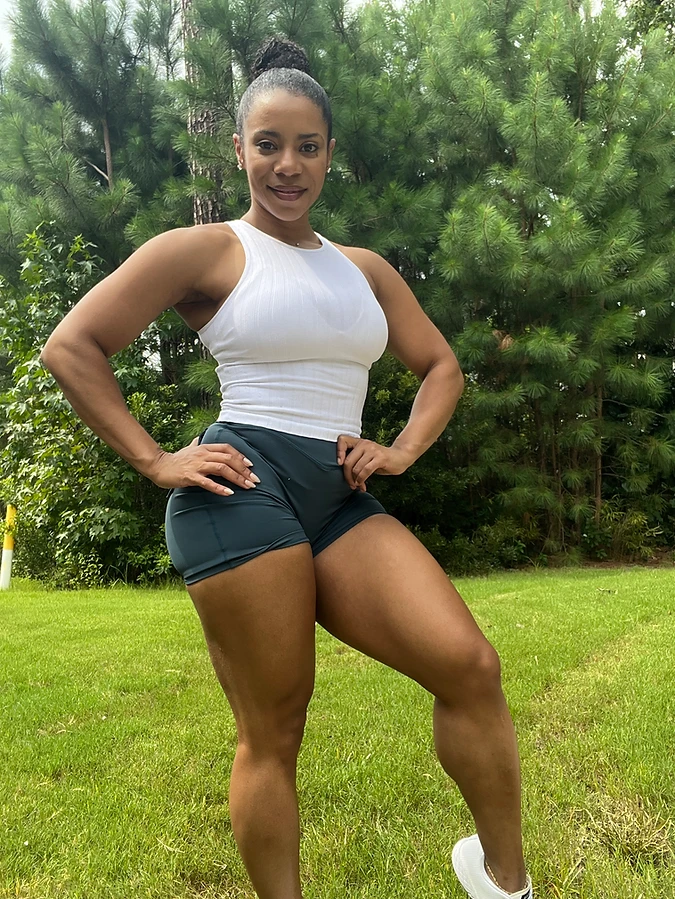
I'm LaToya Loren Price. I'm a board-certified nurse practitioner, a physique coach, and I compete in this sport. I built the Teardrop Hourglass on my own body and I train clients for it. The last two episodes of my podcast, Episode 9, 'The Split' and Episode 10, 'The Lifts', were the training itself. This one is everything else, because you can have the training perfect and still stay exactly where you are.
Why can't you build muscle in a deficit?
Muscle is metabolically expensive. It costs energy to build and it costs energy to keep, so when you eat at or below what you burn, your body will not build new tissue while it is short on fuel.
Your glutes, your quads, and your hamstrings are the biggest muscles you own. They are the most expensive thing on your whole body to build, which makes them the first thing your body refuses to pay for when money is tight.
You can train perfect. In a deficit you are asking your body to build something it cannot afford.
Let me split the room, because this is not universal. If you are brand new to lifting, a fat loss phase might be exactly right for you right now, and you will still build a little muscle while you're in it. Those are beginner gains, enjoy them. This is for the woman with a couple of years in who is strong, who has been eating like she's cutting since before she can remember. Your body is not confused. It has been told to hold instead of build for a very long time.
Recomp or lean build: pick a lane
You have two options. They both work. You have to actually pick one.
Recomp. You eat right around maintenance, enough protein, enough fuel, and you train hard. Your body slowly trades fat for muscle. The scale may barely move, but your measurements will, and more importantly you notice changes in the mirror. For a lot of women that is the difference between staying in it and quitting in week six.
Lean build. A slight surplus. Not a free-for-all, a slight surplus. We're talking 100 to 300 calories, which is about an extra cup of rice, so we are not talking about a ton of extra food. A little extra goes a long way and your body has more to work with, so it builds faster. This is the fast lane to real size.
What does not work is trying to build a bigger lower body while eating like you're trying to disappear. Those are opposite instructions.
The scale is going to move up. Do not bail.
If you build, the number goes up. Do not freak out and bail. That is not the plan failing, that is the plan working. You cannot add to your body and subtract from it at the same time, point blank period.
Most women pull back the second the number moves, and that decision, not their training, is what decided their last two years.
I did the same thing. I trained for a few years and yes, I got toned, but I was smaller, and my goal was to grow some juicy legs and glutes. That didn't sit right with me. It wasn't until I got into bodybuilding that I realized I wasn't eating enough for the work I was putting in or for the goal I had. Nobody ever taught me how to eat more correctly. As women we are conditioned to eat less all the time. Everywhere you turn it's about weight loss, never about muscle building, never about gaining weight on purpose. So it was foreign territory, and yeah, it made me nervous watching that number climb. I ate more anyway. When I finally saw the gains I said okay girl, there go the stallion legs.
Sit in it for a minute. Let it pass.
Building raises your baseline
Everybody talks about building glutes like it's a punishment you survive. It's not. A well-trained, growing lower body is a metabolic asset.
Muscle costs energy to keep and heavy training costs energy to recover from, so as you build, more of your food gets pulled into fueling that work and repairing that tissue. Your baseline metabolic rate goes up. Guess what that means? You get to eat more food permanently just to maintain.
And leaning out later? That becomes easier. Not harder. You have a higher metabolic rate thanks to the added muscle, and you're most likely starting from a leaner position, so you have less body fat to lose. With those two advantages a fat loss phase is much easier.
Compare that to what you've been doing. Years of eating less and less with less and less muscle, until the only lever you have left is eating even less. That's not a strategy, that's a dead end you've been walking down.
How to eat to build
Most women think eating for output means bigger portions of the same food. It doesn't. Three things change.
Protein is the core of every meal, across the whole day. That's the raw material. Without it nothing else matters.
Carbs go around your training. Carbs are what let you push in the session, and pushing in the session is the entire growth stimulus. If you train your hardest leg day on empty because you're afraid of carbs, you're capping your growth.
You fuel for recovery, not just for the workout. What happens after the session is where the growth is. If you underfeed after a hard session all you're doing is creating muscle damage and skipping the repair.
One more thing most women get wrong: they find a set number and eat the exact same thing seven days a week. Same food on a heavy leg day as a rest day. Those are not the same demand. You're either underfeeding the day that matters or overfeeding the day that doesn't.
Does cardio kill glute growth?
Let me be clear before anybody comes for me. Cardio burns calories and it will take fat off you. I'm not going to stand here and tell you it doesn't work.
It just only works for so long, and that's exactly where a lot of women are stuck.
Cardio burns calories while you're doing it. That's the window. Muscle changes what your body burns all day, whether you train that day or not. Cardio can absolutely take fat off you, it just can't hold you there. The only way to stay lean without adding more and more cardio every month is to have more muscle on you.
The bigger problem is that cardio costs recovery, and it comes out of the same account your lower body is drawing from. Add 45 minutes of intense cardio on top of a leg program and you're spending from the exact budget that was supposed to build your glutes. Do a lot of it in a deficit and it gets worse, because now your body is short on fuel and being asked to do more work, and muscle is the most expensive thing it's carrying, so muscle is what it lets go of first. You end up softer, smaller, and flatter, and then you decide you need more cardio. That's the loop.
I know that loop because I lived it. I wanted to drop 10 pounds. I entered an online competition and went at it the way I thought you were supposed to. Twelve hundred calories, cardio twice a day on top of my strength training. I lost 10 pounds and a big piece of it was muscle I had just spent a year building. I was smaller but I wasn't leaner, because I burned through my own muscle on the elliptical twice a day.
Cardio is the accent, not the engine.
Your waist is bloat, not fat
A tight waist is half the Teardrop Hourglass, and most of what makes a waist look thick day to day is not fat. If your midsection changes from morning to night, that is not your body composition. Body composition doesn't move that fast. That's bloat, and it's fixable without dieting harder.
Start with digestion. Pay attention to foods that don't sit right with you and look for patterns that leave you distended. Common offenders are artificial sweeteners, too much or too little fiber, corn, gluten. Half of y'all have been eating something for years that doesn't agree with you and just decided that's how your stomach is.
Then your water and your sodium. Most women are chronically under-hydrated and then swing wild on sodium, and your midsection is where you see it first. Inflammation, bad sleep, high stress, and no recovery all do the same thing. Your body holds water when it's inflamed and the middle is where it shows.
None of that is about eating less. And if your gut is a mess your body can't absorb the nutrients it needs to build muscle, so it's costing you shape too.
The layer most coaches can't reach
Your hormones change how every bit of this behaves. Cortisol changes where you store fat and it goes straight to the middle, exactly where you don't want it for this shape. And perimenopause changes the rules underneath you while you're still running the old ones.
I lived this. When perimenopause hit, everything that worked for me stopped working. It doesn't feel like a hormone problem. It feels like you got lazy. It feels like you lost your discipline. Like you lost yourself. You didn't.
A coach who only knows training cannot help you here. They'll tell you to eat less and do more, which is the exact wrong instruction for a body in that state. Reading what's actually happening and adjusting the fuel and the training around it is a clinical skill, and it's the piece I could not have built this body without.
FAQ
Before you change anything
All of this only works if the training is actually landing. You can eat perfect and still get nothing if the tension isn't going where you think it is.
I made a free tutorial called The 4 Training Mistakes Killing Your Teardrop Hourglass. Why you can't feel your reverse lunges in your glutes, why loading your hip thrust heavier isn't building them, the muscle group you're skipping that builds real width in your legs, and why your hamstrings aren't growing. It's short. Watch it before your next session at gettheteardropmethod.com.
And when you want the numbers built around your body instead of a guess, that's the Physique Design Diagnostic. We look at your training, your nutrition, your recovery, and your goals, find your primary bottlenecks, and build you a personalized 4-week execution map. $99, and you walk out with a plan you can execute immediately.
Get the Free Tutorial.
Strategy. Precision. Level 2. Delivered to your inbox.