The Classic Hourglass Is Dead.
Welcome to the Teardrop Era.
For a decade women were sold the classic hourglass. Light weights, high-rep circuits, shrink yourself smaller. It didn't build the shape you wanted.
The Teardrop Method™ is my 12-week system for building the Teardrop Hourglass™ on purpose. It's the first app built on a coach's actual decision logic. Mine. Not a calculator that counts your food and hands every body the same plan.
It's launching soon. Get on the waitlist and you're first in when the doors open, at founder pricing.
16-second preview. Join the waitlist for the full system.
Grab the Free Tutorial & Join the WaitlistBuild a Teardrop Hourglass, small waist, sculpted upper body, and dramatic curves through hips and thighs, in 12 weeks without random workouts or crash diets.
Most fitness apps are a calculator with a workout attached.
You know the drill. A TDEE calculator spits out a number. A food counter. One training plan, the same one everybody gets. Then it's on you to figure out what to change when nothing changes. This one is built on how I actually coach.
A TDEE number and a macro split from a formula.
Your maintenance from your bodyweight and activity, then your calories set by your goal: cut, recomp, or lean build. Protein at the Protein Constant. Fat never below the floor your hormones need.
One plan. Every body gets the same one.
Lower-body-dominant programming built for the Teardrop Hourglass. Three lower days to every upper, and you pick the upper-body path that fits your frame.
A food log that counts and stops there.
A food log that reads the label off a photo, fills the numbers in, and tells you whether the day was on target.
Progress means the scale went down.
Progress ranked the way I rank it with clients. Execution first. Then measurements and photos. The scale last.
When you stall, you guess.
A weekly check-in that reads your biofeedback and tells you exactly what to do. Hold, add, pull, or fix execution first. Adjustments come every two weeks, one at a time, so you can actually read them.
That's not a template. That's how I coach, built into the thing you open every day.
Your Training Split Is Robbing Your Lower Body.
Here's the Receipt.
You track your macros. You understand progressive overload. You show up. And your glutes look the same as they did a year ago.
That's not a discipline problem. It's where your training is going.
Recovery is finite. You get a set amount of it every week, and every hard session spends some. Heavy pressing. Pull days. Shoulders. Arms. That "balanced" split you were told to run.
Building your lower body is the most expensive thing you can ask your body to do, and by the time you get to leg day most of the week is already gone. So your glutes, quads and hamstrings get the leftovers. Never enough to grow on.
Your upper body isn't the problem here. It should be trained and it should be built. It just shouldn't be eating the recovery your lower body needs to catch up.
The waist is its own mistake. Weighted twists, loaded side bends, heavy oblique work. That's muscle, and it grows like any other muscle grows. You've been training the one place you wanted narrow.
And a waist doesn't get small by shrinking it anyway. It looks small because you built a lower body big enough to make it look that way. That's why the tape won't move no matter how little you eat.
You're not under-working. You're spending it in the wrong place. The Teardrop Method spends it where the shape comes from: three lower-body days to every upper, an upper body trained to frame your lower body instead of compete with it, and core work that sharpens your waist instead of widening it. Same effort. Different split.
You should see what you're buying.
I'm recording the full walkthrough now. Until it's up, here is what's in there, starting with the screen I'd show you first if you were standing next to me: the weekly check-in.
You put your week in. It tells you what to do about it.
Your sessions, your food, your steps, your two anchor lifts, your measurements, your photos, and seven biofeedback markers. Biofeedback just means the signals your body sends back at you: sleep, energy, hunger, stress.
Then it gives you a ruling, in my words, with the reason underneath it. Hold, add, pull, or fix your execution first. Adjustments come every two weeks, one at a time, so you can actually read what changed.
Every other app I have opened gives you a TDEE calculator and stops. The handful that do adjust you over time adjust off scale weight and nothing else. Scale weight is the worst possible input to make that decision on. It moves with your sodium, your water, your cycle, your stress and whether you slept. A woman can put on real muscle, hold flat on the scale for a month, and an app running on scale weight alone will cut her calories for it.
Reading a set of signals together and making the call from the whole picture instead of one number is the job. That's what I do on a 1:1 check-in, and that decision logic is what's in here.
Setup
Four tape measurements and your bodyweight. The app places you on the shape spectrum, you pick your goal, and it sets your calories, protein, fat, carbs and daily steps from there. About four minutes.
Train
My demo video and my cue on every lift, right at the rack, plus what I see women get wrong on it. Log your weight, reps and RIR and it shows you last week and your best.
Fuel
Take a photo of the label and it reads the numbers off the picture. Six meal slots, copy yesterday, saved meals, and a straight answer on whether the day hit.
Progress
Photos at every check-in, and you can put any two of them side by side, including the day you started. Every measurement week over week, your strength curve, and a log of every adjustment and why I made it.
High-Demand-Week Mode
For the week when everything hits at once. Flip it on and the week scales to what you actually have, so one hard week does not blow up the twelve.
The Field Manual
The reasoning behind every rule in the program. Most self-led programs hand you instructions and leave. This one teaches you.
That's the whole thing. No locked tiers, no upsell inside it, no surprise second purchase.
Your 12-Week Blueprint
The four pillars of Physique Design, built into an app that runs them for you. Your programming, your food, your check-ins and your photos in one place.
Physique Assessment
Four tape measurements and your bodyweight. The app places you on the shape spectrum and names your starting point.
You pick one thing, your goal: cut, body recomp, or lean build. The app sets your calories, protein, fat, carbs and daily steps from there.
Setup takes about four minutes. Then you seal it. One purchase, one program. No restarting on Monday.
Strategic Training
Twelve weeks in three phases: Foundation, Progression, Optimization. Sets, reps, tempo and RIR set for each phase, with intensifiers earned in the last block.
Three lower-body sessions to every upper. Quad focus, hamstring focus, glute focus, rotating so nothing gets left behind. Four or five days, your pick.
You choose your upper-body path: the sculpted frame or the slim frame. Trained for shape, never for size.
My demo video and my cue on every lift, right at the rack. Log your weight, reps and RIR and the app shows you last week and your best.
The Tapered Waist Core Protocol. Two targets. The rectus abdominis, the muscle you actually see, trained with direct flexion. And the transverse abdominis underneath it, your body's internal corset, trained to brace. What is out is direct oblique work: no loaded side bends, no weighted twists, nothing that builds width where you want taper.
Precision Nutrition
Protein set at the Protein Constant, and it never moves. Fat never drops below the floor your hormones need. Carbs do the work.
When calories come out, they come out in the order that protects a woman's body. Not the textbook order.
Log food by search, by hand, or by taking a photo of the label. Six meal slots, copy yesterday, and a straight answer on whether the day was on target.
Real-Life Integration
The weekly check-in is a decision system. Sessions, food, steps, measurements, photos, and seven biofeedback markers. It scores your week and tells you what to do, in my words. Hold, add, pull, or fix execution first. Adjustments every two weeks, one at a time, when the data earns it.
High-Demand-Week Mode. Turn it on for the week that gets heavy and the app runs the minimum effective dose that keeps the twelve weeks intact. Forty minutes, in and out.
Photos at every check-in, required at Week 6 and Week 12. Put any two of them side by side, including the day you started, with the measurements for each and what changed between them. Every measurement week over week, your strength curve, and a log of every adjustment and why.
The Field Manual. The reasoning behind every rule, so you understand the plan instead of just following it.
The founding cohort group. Private and hidden, so nobody outside it can find it or see who is in it. Post your wins, the session you nearly skipped, and anything in the app that confused you. Founding members only, and entirely optional: the program works whether you post every week or never say a word.

The Primary Case Study Is
My Own Body.
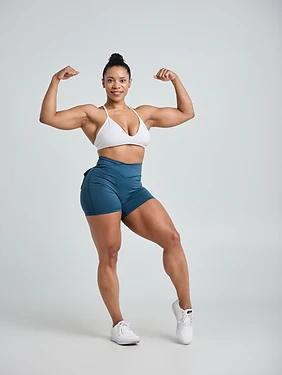
I'm LaToya Loren, board-certified nurse practitioner, national-level bodybuilding competitor, and the primary case study for this method.
I compete at the national level in a bodybuilding division built on lower body dominance: visible quad sweep, full glutes, and a sculpted upper body that stays proportionally smaller than the lower frame. The exact physique women are chasing online but can't figure out how to build.
I didn't reverse-engineer the Teardrop from other people's photos. I built it on my own frame. Upper body trained for definition without the mass. The dense work and the food routed into my lower body. Heavy compound lifts counted toward the total load instead of stacking more on top.
That's not a testimonial. That's the method, standing in one body.
MSN, APRN, FNP-BC | FWLC | NASM-PBC
This Is Not a Generic Fitness Program.
First, so nobody counts herself out for the wrong reason. You do not have to already be a Teardrop Hourglass to train like one. Your frame influences the shape. It does not get the final say. What decides whether this is for you is your goal, not your measurements.
With that said, this program is not for everyone. If you want "balanced" upper and lower body development, wide shoulders to match wide hips, symmetrical X-frame aesthetics, this is not your program. There are a thousand programs built for that goal. This is not one of them.
The Teardrop Method is a 12-week system built for one shape: a sculpted, athletic upper body with a dominant lower body. Defined shoulders, sculpted arms, a strong back, paired with thick, powerful lower body curves. Sweeping quads. Full glutes. Visible hamstring separation. A tight waist that lets your curves do the talking.
If that is not the body you want, do not buy this program.
What This Program Requires
Commitment to the full 12 weeks.
This is not a "try it for a week and see how you feel" program. Muscle takes the time it takes. You will not see the full shift in Week 2. You seal your goal at setup and you run the twelve weeks.
Access to real equipment.
Barbells, dumbbells, and the ability to progressively load lower-body movements (RDLs, squats, lunges). This is a heavy-lifting protocol. A resistance band and a yoga mat will not deliver the required stimulus.
Willingness to follow the program as written.
This is not a "pick and choose what you like" system. The whole method is built on where the volume goes. If you add extra upper body work because it "feels wrong" to do less, you will break the system.
The maturity to trust a counterintuitive process.
If you're used to grinding every session, training your upper body with precision instead of maximum volume will feel like doing too little. That discomfort is the method working.
What This Program Does NOT Require
This is not a beginner program or an advanced program. It's a commitment-level program. It works for the woman who is ready to stop piecing together random Instagram workouts and follow a complete system for 12 weeks, whether she's lifting for the first time or the hundredth time.
So if you want to build a bigger, stronger, more developed lower body, this is your program. Whatever box a chart sorted you into before.
Finish the twelve weeks and the Diagnostic is on me.
I don't hand out the Diagnostic for signing up. I hand it to the women who finish. Do the work, show me the before and after, and the next step is free.
Save your Week 0 photos when you start.
Front, side, back. Same spot, same light. This is your starting point, and nobody sees it unless you say so.
Finish the twelve weeks. Save your Week 12 photos.
The app puts them side by side with Week 0. Then it asks you a few questions about how it went.
The app unlocks your Diagnostic.
A code for a free Physique Design Diagnostic, my 45-minute working session, normally $99. That's the next door, and you earned it.
Your photos are yours. You choose at Week 0 whether they can ever be shared, and the app asks you again at Week 12.
The Blueprint Exists.
The Only Question Is Whether You'll Build It.
It's launching soon. Get on the waitlist and you're first in when the doors open, at founder pricing.
Prefer to start free? Grab the tutorial first: The 4 Training Mistakes Killing Your Teardrop Hourglass.