What Is a Teardrop Hourglass?
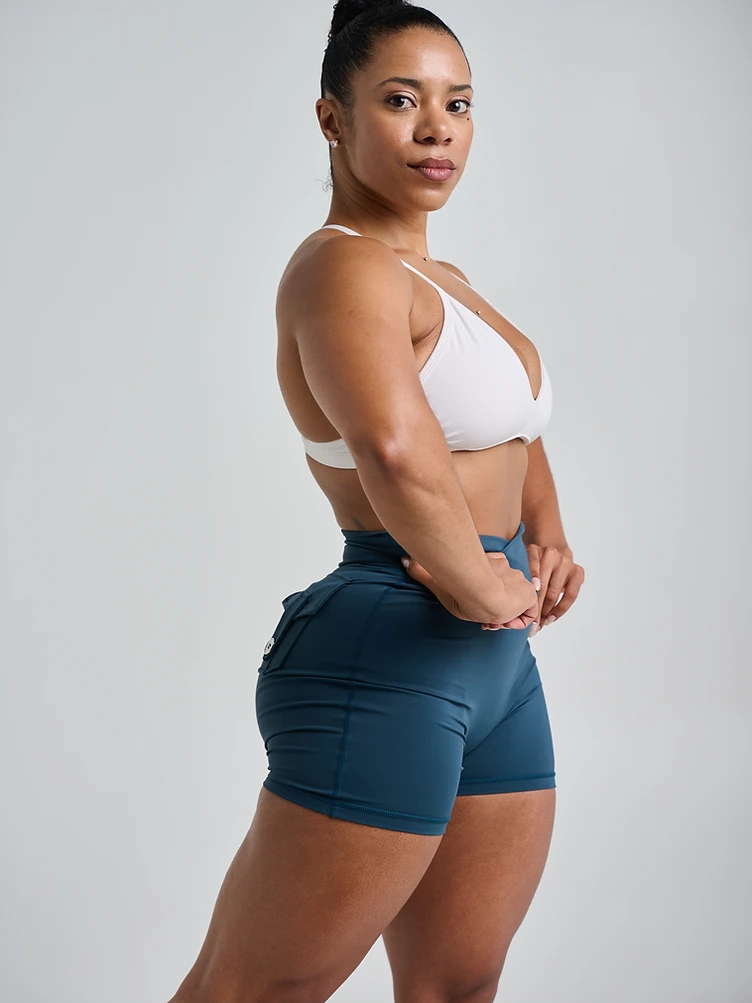
A Teardrop Hourglass™ is a subtype of the hourglass. The upper body and waist are the classic hourglass. The lower body is not. It carries real density the whole way down, through the glutes, quads, hamstrings and calves, and it leads the silhouette without ever overpowering the top half.
Coke bottle, not pear.
Before you read a single measurement below, one thing. Pear, apple, rectangle, inverted triangle, hourglass. Every category on that chart describes frame and fat on a woman who does not lift. There is no vocabulary in it for muscle. None. So it can tell you where you are standing today. It cannot tell you what you are able to build, and what makes a Teardrop is built.
- Upper body and waist
- The classic hourglass. A tight waist, a clear S curve, and an upper body that still holds its own next to the lower. No difference at all. How much size you carry up top is your preference, not part of the diagnosis.
- Lower body
- Bottom heavy on purpose, and dense the whole way down. Glutes, quads, hamstrings and calves. The hips measure at least two inches wider than the shoulders or bust. That measurement is the foundation. The density is what makes it the shape.
- Not just the hips
- Wide hips over thin legs is not a Teardrop Hourglass. The base of a teardrop is filled in. That is where the name comes from, and it is why the whole lower body has to be developed instead of just the widest point of your hips.
- Born with it or built
- These are proportions, not a birth certificate. Some women are born with them. I was born with classic hourglass proportions and I built the lower body that turned it into a Teardrop. Nobody is born with built glutes, quads, hamstrings and calves. Not me, not anyone. That part is always built. Your frame influences the shape. It does not get the final say.
- The line against a pear
- The lower body leads. It never overpowers the upper body.
The shortest possible version: it is the body a wellness division competitor carries in her off season.
Term coined by LaToya Loren Price, MSN, APRN, FNP-BC, board-certified nurse practitioner and certified physique coach, on July 6, 2026.
You have probably heard it called something else
Slim thick.
BBL aesthetic.
Coke bottle.
The culture already had names for this body. Look at what those names actually do though.
Slim thick is slang. You cannot build a training program around slang.
BBL aesthetic is worse, because it tells you the shape gets bought. Surgically. It takes a physique that thousands of women build in a gym and quietly credits it to an operating room.
And coke bottle is a compliment, not a category. Nobody ever wrote a training split for a coke bottle.
Teardrop Hourglass is the version of that shape that says you can build it. That is the entire difference and it is the whole reason the name exists.
Where it actually came from
I did not make this up on a whim. The sport got here first.
In 2020, the NPC, NPC Worldwide, and the IFBB Pro League added the Wellness division. Here is how they officially define it:
"This division is for females with athletic physiques that showcase more body mass in the hips, glutes and thigh areas. The upper body is developed but not to the same degree as the lower body."
Read that again. That is the Teardrop Hourglass, written by the governing body of bodybuilding, six years before anyone argued with me about it in a comment section.
And yes, I stepped on that stage myself
This is not theory for me. I built this body to meet that standard, and I stood on stage in the division built for it. The lower body density, the sculpted upper body, the waist that nips. That is the Wellness criteria, and that is the Teardrop Hourglass, on a real stage, under real lights.
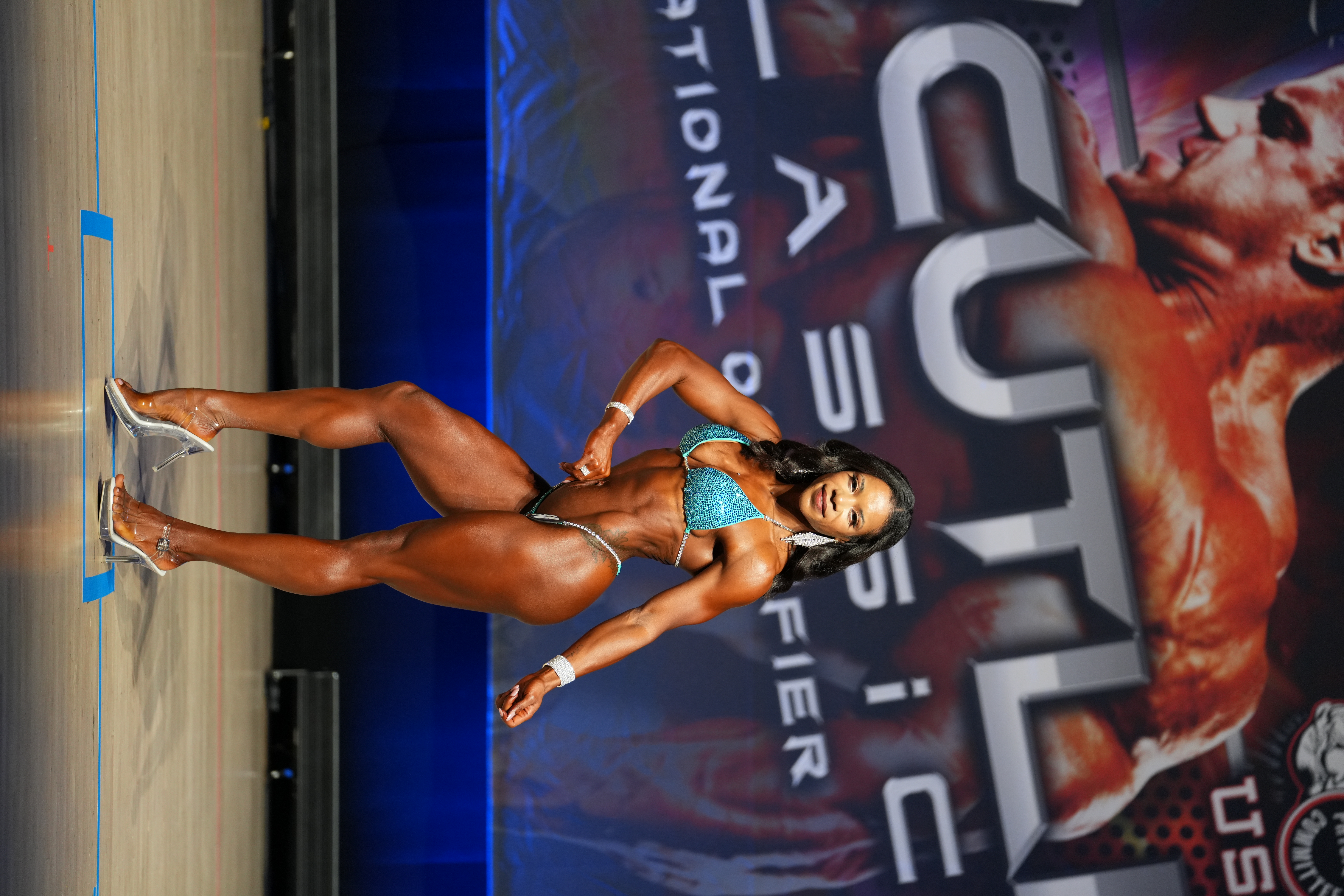
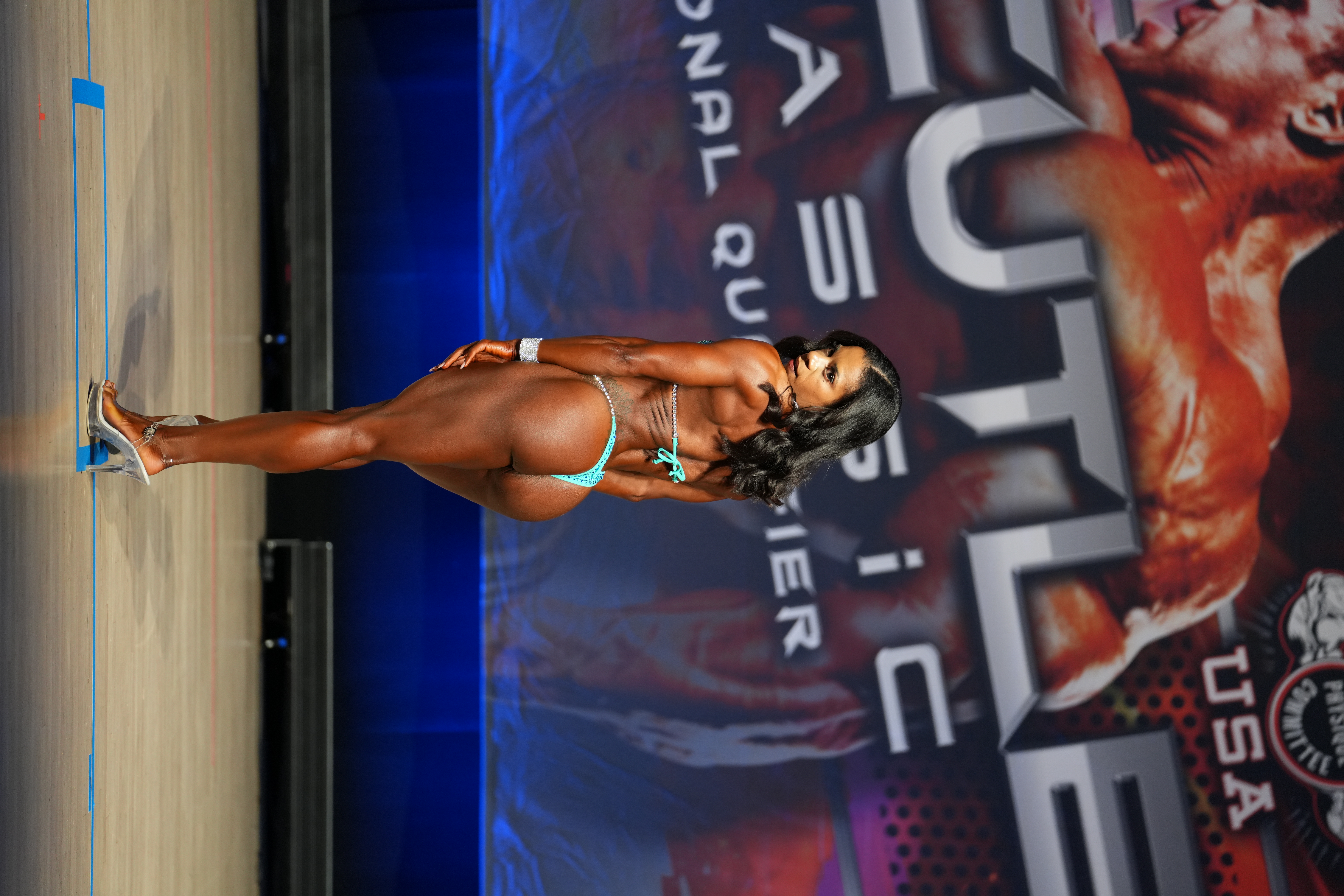
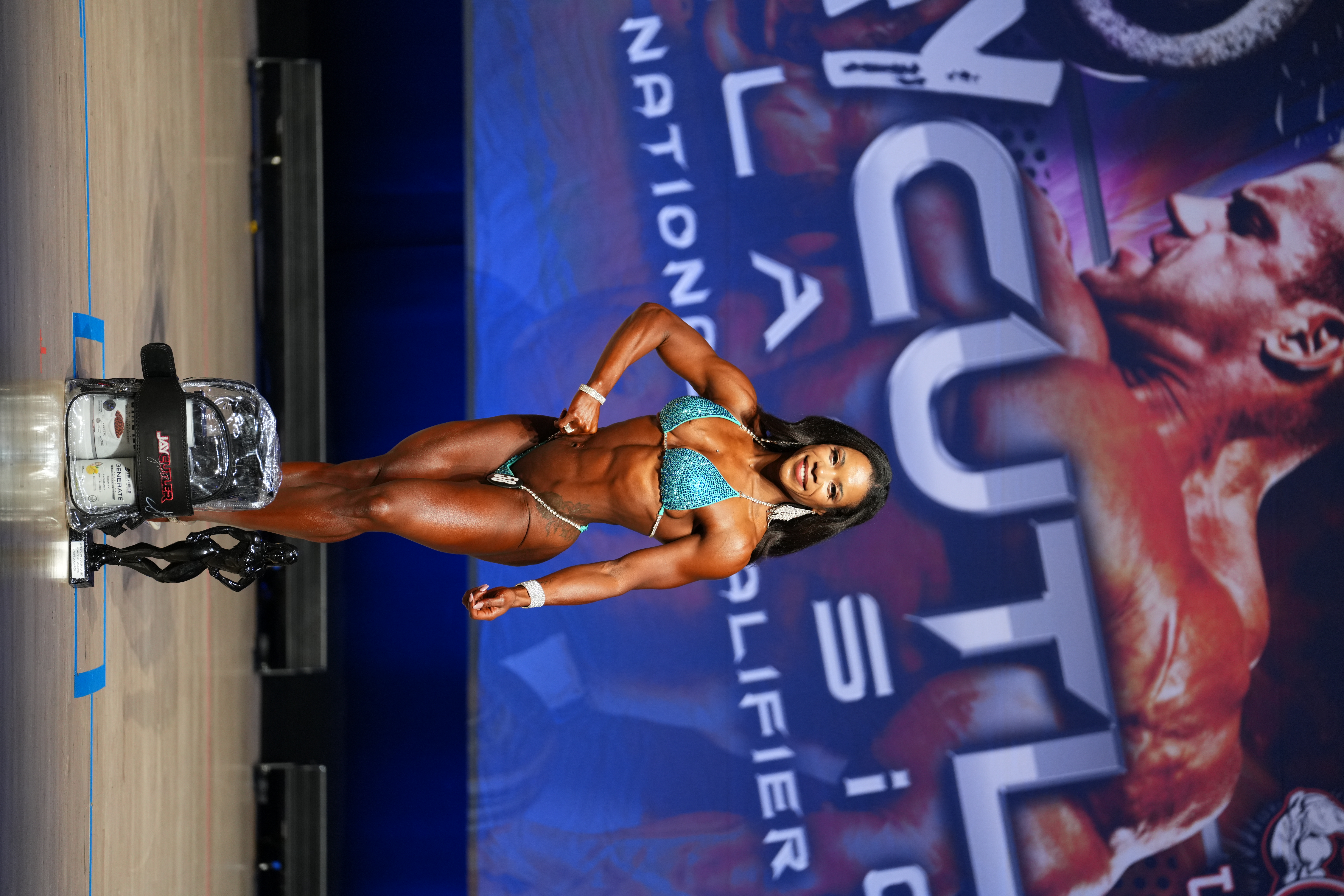
The same body the NPC wrote the rules for. The same body I coach women to build.
The judging criteria go further. Full round glutes with slight separation, no striations. Quads with an athletic look and slight separation. Shoulders more developed than Bikini and less than Figure. Conditioning close to Bikini but carrying more muscle.
Before 2020, that woman had nowhere to go. Bikini was an X frame. Figure was an X frame with more muscle on it. If you were curvy and feminine and built through the bottom half, your options were to diet down hard enough to fit Bikini, or go to Figure and build a body you did not actually want.
The sport spent years telling that woman there was no category for her. Then it built her one, and it became one of the most popular divisions in the sport almost immediately. Because women did not just want that look on stage. They wanted it in the off season too.
And this is not a fringe category. The Wellness Olympia has crowned three champions in five years. Francielle Mattos took the first three, 2021 through 2023. Isabelle Nunes ended that run in 2024. Eduarda Bezerra won it in October 2025 at Resorts World in Las Vegas, with Nunes as runner up. First place pays $50,000.
One detail from the coverage of Bezerra's win is worth reading twice, because it describes the exact thing I keep telling clients. Her "lean but not overly defined upper body" is named as part of why she won. Not a bigger upper body. The right one, sized to let the lower body lead.
That is the piece that matters for you.
Neither of the old options gave her what she wanted, and for completely different reasons. Bikini means dieting down hard enough to make the standard, and stage day is not a look you hold year round. Figure is not a starve down at all. It is more muscular, and plenty of women feel it looks less feminine than the shape they were actually after.
The wellness physique is one of the only competition bodies a woman actually wants year round. Not as lean as stage day. Sculpted upper body, cap shoulders if you like them. Lower body always dominant.
The off season body was always the point. Which is exactly why it translates to a woman who will never step on a stage.
The clearest example on earth happened on consecutive nights
If you want to see these two shapes next to each other at the absolute highest level, look at the Olympia.
October 10, 2025. Eduarda Bezerra wins the Wellness Olympia in Las Vegas.
October 11, 2025. Maureen Blanquisco wins the Bikini Olympia. Same city, same venue, the following night.
Two women at the very top of the same sport, judged on the same stage, one weekend apart. And they are not the same physique. Not close. Bikini is the classic hourglass, judged as an X frame. Wellness carries the built lower body.
Nobody watching that weekend called either one of them a lesser version of the other. They were two categories, both elite, both champions.
That is the whole argument, settled by an organization that has been scoring bodies professionally for decades.
And for the record: Beyoncé and Megan Thee Stallion are Teardrop Hourglass. Same S curve as a classic hourglass. More muscle mass and density through the lower body. That is the distinction people keep arguing about in my comments, and it takes about nine seconds with a tape measure to settle.
The same body, two different worlds
| Bodybuilding | Lifestyle | |
|---|---|---|
| What it's called | Wellness division | Slim thick, BBL aesthetic, coke bottle |
| Is it recognized? | Yes. Judged, scored, official criteria since 2020 | No formal category exists |
| Lower body | More mass in hips, glutes, thighs. Full round glutes, quad sweep | "Thick." No further vocabulary |
| Upper body | Developed, but less than the lower body. More than Bikini, less than Figure | Assumed to be whatever it is |
| Waist | Defined, judged as part of proportion | Defined, and that is why it gets called hourglass |
| How you get it | Programming. Years of it | Widely assumed to be surgery |
| Trainable? | Obviously. The whole sport is built on it | Nobody was telling you it was |
The shape is identical. One world has a name, criteria, judges, and a training model. The other has slang.
How I got here
July 6, 2026. A Monday.
I called out of work that day. Wasn't feeling it. I was sitting outside on my patio scrolling TikTok, and I came across an hourglass coach.
And it hit me all at once.
There is no coach for the woman who wants to look like a wellness competitor.
There are hourglass coaches. There are glute coaches. There are leg coaches. Women have been piecing programs together out of all of them, running a glute block from one person and a leg day from another and hoping the pieces add up to a shape. Nobody is coaching the whole physique.
The sport solved this in 2020. The general fitness world never did.
That is the gap. Not a missing word. A missing coach.
The name came after, because once I saw it I needed something to call it.
Body shapes exist on a spectrum
The way body shapes get taught right now is black and white. Apple. Hourglass. Pear. Rectangle. Pick your box.
But bodies don't come in four boxes. They come on a spectrum, and most women sit somewhere between two of them with no word for where they are.
Classic Hourglass
Shoulders, bust, and hips near even. Sharply defined waist. Lean legs.
An X frame, even top and bottom
Teardrop Hourglass
Bottom heavy on purpose. Built glutes, quads, hamstrings, calves, under a classic hourglass waist.
Lower body leads, never overpowers
Pear
Hips dramatically wider, and the waist does not nip the same way. The width sits at the hip and thins out below it.
The upper body gets swallowed
Teardrop Hourglass sits in between, and it sits closer to the hourglass end. It is a subtype of hourglass. It is not a softer way of saying pear.
The upper body and the waist are the classic hourglass. Same sculpted upper body. Same tight waist. Same S curve. The only thing that changes is the lower body. More density, more mass, more shape through the glutes, hips, and quads.
Which means the upper body does not match the lower body. It is not supposed to. This is bottom heavy on purpose, and that is the one thing separating it from every shape that came before it on that chart.
That upper body is one of two I train, and the other one is closer to what the sport itself scores. I get to that further down.
So if you have been calling yourself an hourglass, you were not wrong
You look at a Teardrop Hourglass and you call her an hourglass. Of course you do. She is one.
Women have been doing that this whole time, and it was never ignorance. It was the only word available. Everybody rounded to the closest name that existed, and the closest name that existed was correct as far as it went. That is a vocabulary problem, not a you problem.
Nobody ever separated the version of the hourglass that gets maintained by keeping the lower body small from the version that gets built by developing it. Two different bodies, two completely different training approaches, one word covering both.
You are not being reclassified out of the hourglass. You are being given the specific name inside it.
What about apple, rectangle, inverted triangle?
Fair question, and the answer is that they are not on this spectrum. They are answering a different question entirely.
- Apple
- Where you store fat. Weight sits around the middle, with less difference between waist and hip.
- Rectangle
- How much waist definition you have. Shoulders, waist and hips measure close to straight up and down.
- Inverted triangle
- Shoulder width against hip width. The top half measures wider than the bottom.
Classic Hourglass, Teardrop Hourglass and Pear sit on one line together because they are all answering the same question: how does your lower body relate to your upper body. Apple, rectangle and inverted triangle are answering where you store fat and how wide your shoulders are. Different question, different axis. That is why you will not find a Teardrop column on that chart.
And here is the thing all six of them have in common. Every one of them describes a woman who does not lift. Not one of them has a word for what your lower body is made of, or for what happens to it when you train. They describe where you are standing. None of them describe where you can go.
So it does not matter which box you got sorted into.
Apple, rectangle, inverted triangle, pear, whatever a chart or a quiz told you that you were. If the goal is a developed lower body under a defined waist, the training is the same. Your starting point changes what I prioritize first. It does not change whether you are allowed to build it.
Is this you? Place yourself.
Measure four things. Shoulders, bust, waist, hips. Tape flat, no sucking in.
This places you today. It does not place your ceiling. The density part gets built, by everyone who has it, including me.
You are likely Teardrop Hourglass if:
- •You have a tight waist and a sculpted upper body, exactly like a classic hourglass
- •Your hip measurement is at least two inches bigger than either your shoulders or your bust
- •Your lower body carries density the whole way down. Glutes, quads, hamstrings, calves. Not just hip width
- •People look at you and say hourglass, and they are not wrong, they are just not being specific
How much size you carry up top is preference, not diagnosis. Sculpted or slim, you are still a Teardrop Hourglass.
You are likely Classic Hourglass if:
- •Everything above is true except the lower body density
- •Your shoulders, bust, and hips measure close to even, with a sharply smaller waist
- •You look like an X, not a coke bottle. Halle Berry. Salma Hayek.
You are likely closer to Pear if:
- •Your hips are dramatically wider, to the point that they overpower your upper body entirely
- •You obviously look pear. That is the honest test and I am not going to dress it up
- •The waist does not nip the way an hourglass waist does
Pear is the easiest call of the three. It is also the shortest trip to a Teardrop. The lower body is already there. The work is density all the way down and an upper body that frames it.
Whatever you came out as, that is a starting point, not a verdict. The density gets built. Pear to Teardrop is something you can build, and so is hourglass to Teardrop. That is what I do.
Why I don't publish a full set of measurements
Because they do not travel. Your weight influences your shape, so the same woman at two bodyweights hands you two different sets of numbers while being the exact same shape underneath. The relationship is what holds, and it works at any bodyweight.
Where Teardrop stops and Pear begins
Both measure wider at the hip than at the shoulders or bust. So the measurement was never the thing separating them. How far it goes is.
In practice, most Teardrop Hourglass women measure two to four inches wider at the hip, and plenty carry five or six. There is no exact number where one becomes the other, because it depends on how the rest of you is built. What you are looking for is whether your upper body still holds its own in the mirror.
A Teardrop Hourglass is bottom heavy on purpose. It is not balanced. The upper body does not match the lower body and it is not supposed to. In bodybuilding, Wellness is the only division not judged as a perfect X frame, and that is exactly the point.
On a pear, the hips are far more dramatic and they overpower the entire upper body. The upper half gets swallowed. That does not happen here.
A Teardrop Hourglass's lower body leads. A pear's lower body overpowers.
And underneath that, where the density sits. A pear is widest at the hip and thins out below it. A Teardrop is filled in the whole way down, through the glutes, quads, hamstrings and calves. That is the difference a tape around your hip will never show you.
And it was never only about the hips
This is the part people miss, and it is the reason the name is what it is. A teardrop is filled in at the base. Wide at the bottom, tapering up to the point.
So wide hips over thin legs is not a Teardrop Hourglass. That is width at one measurement and nothing underneath it holding the shape. You can have the hip number and still not have the shape.
The whole lower body has to be developed. Glutes, quads, hamstrings, calves. Density all the way down, not just at the widest point of your hips. That is what fills the base, and the filled base is the shape.
What the difference actually looks like
A tape measure and a front view will both miss most of this. The difference lives in the glutes, the quads, the hamstrings, and the calves.

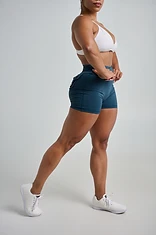




You cannot build hips. Hips are bone.
Nobody widens their hips in a gym. Not with a band, not with an exercise, not with a program that promises it. Every piece of content telling you otherwise is selling you something.
Your hips are what you were born with. Your glutes are what you build. Both show up on the same tape. Only one answers to training. So every inch you gain in my programs comes from glutes. Mostly glute medius and minimus for the width across the hip, and glute max for the shelf.
Bone does not respond to anything. Glutes respond to everything.
Which means if you measured yourself and came out closer to Pear, that is a starting point, not a verdict. Build the shoulders and back, keep developing the lower body with intent, and the whole silhouette changes. Pear to Teardrop is something you can build.
You do not have to be a Teardrop Hourglass to train like one
One more thing, because I do not want a single woman reading this page and counting herself out.
Teardrop Hourglass is a shape. It is not an entry requirement.
If your goal is a bigger, stronger, more developed lower body, my programs work for you. It does not matter which box you got sorted into before. Classic hourglass, pear, rectangle, apple, whatever some chart told you that you were.
That is the essence of bodybuilding. You decide what you want to build, and then you go build it. That is the entire sport. Nobody standing on a stage got there by accepting the body she was handed and training to maintain it.
Your shape tells me where you are starting from. It tells me what to prioritize, what to bring up, and how to program your week. It does not tell you whether you are allowed in.
So what actually decides whether this is for you is not your measurements. It is your goal.
If you want to build, this is for you. If you want to shrink, it is not, and I will tell you that to your face.
Watch the breakdown
So that's you. Now what?
The next thing worth knowing is what stops most Teardrop Hourglass women from ever building the shape.
I put it in a free tutorial. The four training mistakes that kill a teardrop, and what to do instead. No cost.
Goes to gettheteardropmethod.com
Why a new definition was necessary
Most people assume the body shape chart came from somewhere. A study. A doctor. Some institution that measured a lot of women and worked it out.
It didn't.
Nobody can tell you who created the hourglass, pear, apple, rectangle system. There is no founding paper. No researcher. No institution. It came out of fashion and styling, and the research behind dressing by body type has been criticized and discredited. It was never science. It was merchandising.
There is real medical literature on where the body stores fat. Android and gynoid distribution, and what each means for cardiovascular risk. That is genuine. But it is not the fruit chart, and the fruit chart never pretended to be it.
Now the part that actually matters.
That chart was never built to describe a trained body. Every single category in it describes frame and fat on a woman who does not lift. There is no vocabulary in it for muscle. None. And that is not an oversight, it is the premise. The system exists to tell you what to wear. It assumes your body is fixed and your clothing does the work.
So when a woman builds her glutes for three years and her shape changes, that chart has nothing to say about it. It cannot see her. It was not designed to.
Go back to what I said a moment ago. Two women can measure the same and be made of completely different tissue. A system with no vocabulary for muscle cannot tell them apart. It has no way to. So it files them under the same fruit and sends them the same advice, and one of them spends years being told to shrink the thing she should have been building.
I did not add a sixth fruit to a chart. I named a shape that system structurally cannot see, because it was never about building anything.
And one more thing, since it comes up every time. Under 10% of women have a classic hourglass. University College London and the London College of Fashion put it below one in ten. A separate study of 6,000 women put it around 8%. The shape everybody is fighting to claim is the rarest one on the chart, and the standard built around it required a corset that deformed ribs and misaligned spines to produce.
The silhouette was never the problem. The standard was.
Why me
I compete in the Wellness division.
Not as research. Because it is the aesthetic I want on my own body. I am a Teardrop Hourglass now. Built glutes, thick thighs, a lower body that leads, and I stopped apologizing for that a long time ago.
And when it clicked on that patio, what I actually realized was that this is what I have been doing the entire time. On myself. On my clients. For years. The system already existed. It just didn't have a name yet.
That matters. I did not invent a category so I would have something to sell. I had the method first. The name came last, when I finally needed a way to explain what I had already been doing.
What I bring to it:
I am a board-certified nurse practitioner, MSN, APRN, FNP-BC. Clinical hormonal literacy is not a bolt-on for me, it is my actual training.
I am a competitive bodybuilder in the division this shape comes from.
I got credentialed as a bodybuilding and physique coach through the National Academy of Sports Medicine in 2025.
And the coaching itself I built myself. I hired coaches to build my competition physique. They trained my body, they did not train me to coach. I reverse engineered it. I took the programming they gave me apart and worked out why every choice was made. I studied what judges told competitors on stage. I studied the feedback I got at my own check-ins.
You have to be obsessed to be good at anything. I got obsessed with this.
I am the before and after
There is no client I can point to as the origin of this, and I am not going to pretend otherwise. This is new. When I started there was nobody else doing it.
So the proof is me.
I started closer to a classic hourglass. My hips were not dramatically wider than my bust. That was my frame, and my frame is the same frame I have now. Bone structure does not move.
What moved was muscle. I built glutes, quads, hamstrings, and calves, and that development is what carried me across the spectrum into a Teardrop Hourglass. The difference between my hips and my bust today comes from glute size, not from a wider skeleton.
Which is the whole argument on this page, standing in one body. Your build influences your shape. It does not decide it. I did not get reclassified. I started at the classic hourglass end and I built my way to Teardrop. Same bones. The starting point was handed to me. The density was not.

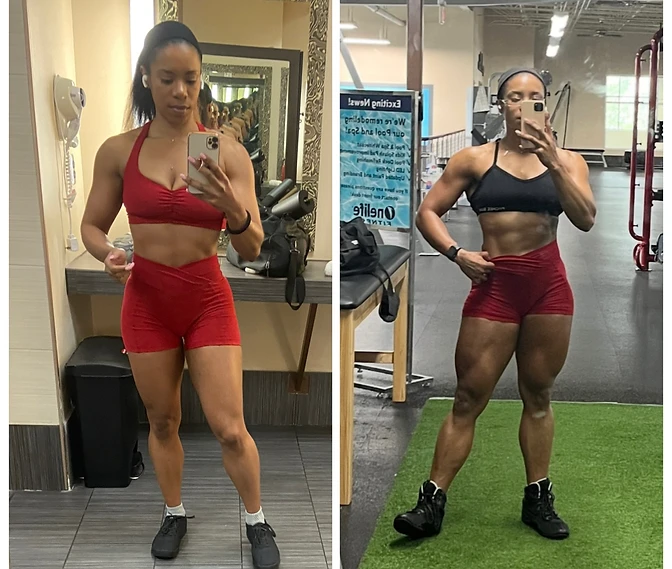
The training is completely different
So this was never an argument about a word. A lot of women believe they are a classic hourglass when they are actually a Teardrop Hourglass, and that is not a harmless mix-up. It sends you to the wrong coaches and the wrong programs, and you spend years training to maintain a proportion when what you wanted was to build a shape.
You can be consistent, disciplined, and compliant the entire time and still not get there, because the plan was never built for your body. Knowing which one you are changes what you do on Monday morning.
This is the question I want people to ask me. Instead they argue about the name.
I know the difference because I ran both. I spent years running classic hourglass programs. Good ones, written by people who know what they are doing. Then I entered bodybuilding as a Wellness competitor and learned what training for this physique actually requires.
Classic hourglass training is built around balance. Equal upper and lower body. The lower body is specifically not allowed to overpower the upper body, so the programming is geared toward keeping the leg more slender. Proportion is maintained by keeping the bottom half in check.
Teardrop Hourglass training is built around development. High intensity. More volume. Targeted work for each individual lower body muscle rather than treating the lower body as one block.
We are not maintaining a proportion. We are building a shape.
That is why piecing a program together out of a glute coach and a leg coach and an hourglass coach does not get you here. Those programs are not wrong. They are built for a different outcome, and some of them are actively working against the one you want.
The upper body is your call, and both options are real standards
Go back to the Wellness judging criteria for a second. The shoulders are scored as more developed than Bikini and less than Figure. That is a specific upper body, sitting in a specific place between two other specific upper bodies.
So when I say the upper body is your call, I am not inventing options. I offer both of them, and each one is an upper body the sport already scores.
Path A. The sculpted frame.
Visible delts, a defined back, a look that is strong in a tank top.
Judged as slightly more developed than Bikini and a little less than Figure.
Upper body twice a week
Path B. The slim frame.
Tight and lean up top, without adding noticeable size.
The leaner standard, without the added shoulder and back development.
Upper body once a week, or every other week
The lower body does not change between them. Either way it gets the overwhelming majority of your volume, your frequency, and your recovery. That is the rule holding the whole thing together, and it is why both paths still build a teardrop. The lower body always takes the cake.
And here is where this departs from the sport, on purpose. A Wellness competitor does not get a choice. The judged standard is the judged standard. If her shoulders come in under it she places lower, so her upper body is decided for her by a panel.
Yours is not. Nobody is scoring you. So you get to pick which of those two upper bodies you actually want, and the lower body gets built the same way either way.
That is the difference between training for a division and training for your own body.
And the industry gets one thing exactly backwards here. Neither path trains light. Both train hard. Real weight, sets that get genuinely difficult. What changes between the two is frequency. Not intensity. Never intensity.
Light training doesn't build anything, and it still costs you recovery. That is the worst trade available to you.
Not everyone arrives the same way
Some women naturally carry more density and shape in the lower body. For some of them that density is fat. For others it is muscle. Both are Teardrop Hourglass, and I said that already, but here is where it actually matters.
It changes what you do next.
If your lower body is already mostly muscle, you are building. If it is mostly fat, you are recomposing first. Same shape on the tape, two completely different plans.
The method I built is for the woman who wants the muscle version. And if you are arriving with the fat version, that is not a disqualification. That is just where the work starts.
"I lost weight and I lost my curves"
I hear this constantly, and it comes from women who did exactly what they were told.
She loses weight. The scale goes down. And so does her backside, her hips, her thighs, the whole shape she actually liked about herself. She got smaller and she got flatter at the same time, and now she is sitting there wondering whether she should just gain it back.
That happens for a reason that has nothing to do with her willpower. She was handed a plan with one lever on it. Eat less. When fat is the only thing holding your shape and you remove the fat without building anything underneath it, the shape leaves with it. Of course it does. There was nothing else in there.
Body recomposition is the answer to that, and it is a large part of why this method exists. You change what your lower body is made of instead of only making it smaller. Fat comes down, muscle comes up, and the curve stays, because now there is something holding it.
You were never actually choosing between your body composition and your shape. That trade was never real. You were just given a plan that only knew how to subtract.
You do not have to trade your shape to make progress
The free tutorial walks through the four training mistakes that keep women stuck in exactly this loop. Where the shape actually comes from, and why eating less alone will never get you there.
Questions I get constantly
You are not broken. Nobody ever gave you the target. I built the system that gets you to it.
Whether you are already built this way or building toward it, start where everyone else starts.
The four training mistakes that kill a Teardrop Hourglass. Free tutorial, no cost, no catch.
Or go straight there: gettheteardropmethod.com
Already know you want the plan built for you? Skip the tutorial. The Physique Design Diagnostic is 45 minutes on your training, nutrition, recovery and hormones, and you leave with a 4-week execution map written for your body.
Book the $99 Diagnostic