Why Squats and Deadlifts Aren't Building Your Lower Body
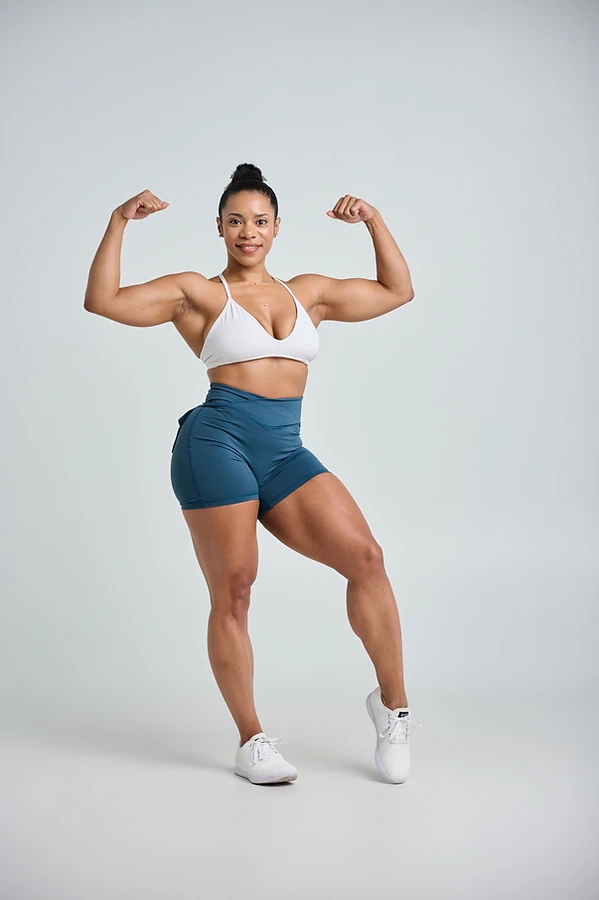
You've been squatting for three years. You're strong, you've got a deadlift you'd mention if somebody asked, and your lower body looks about the same as it did a year ago. You made some progress early, then it stalled. So you pushed harder, added reps, tried a few different leg programs, and the needle wouldn't move.
That is not a discipline problem. And I'm about to say the thing that sounds wrong: you do not build this shape with barbell back squats and conventional deadlifts.
Don't hear that as me trashing them. Basic compounds build strength and power. They build your foundation, and you want that foundation. They are just not the lifts that build the shape on top of it. I'm LaToya Loren Price, board certified nurse practitioner, physique coach, and competitive bodybuilder. Last time I showed you the split that builds a teardrop. Here are two clean reasons why those lifts stall your shape.
Why did my legs stop growing even though I squat heavy?
Reason one is that your back becomes the bottleneck. When the weight is sitting on your spine, your back can only load so much before it taps out. Your legs are working, they may even be sore, but the bar stops at what your back can hold, not at what your legs could actually grow with.
And a back squat is a compound movement. It spreads the load across a whole bunch of muscles at once. So what you build is generalized growth, a slightly bigger overall leg, not the targeted growth that builds a specific shape. That's why a woman can train hard for years and end up a firmer version of the same body. I lived it. My legs got sore, I had some early progress, then it flatlined. More reps, more programs, nothing moved. I was doing the wrong exercises for the outcome I actually wanted, which was shape.
Why isn't my deadlift building my hamstrings and glutes?
Reason two is that a conventional deadlift is a power movement. It is explosive by design. You are pulling weight off the floor as fast as you can, and speed is the entire point. That's a real skill and a beautiful lift. It is a different sport.
Because you cannot build a muscle you are moving through quickly. Growth comes from tension, and tension requires time under it. Here is the whole thing, and it decides how you look at every lift from now on:
Basic compounds build strength and power. They're not meant to build shape. They create the foundation you build a shape on.
What actually builds a teardrop lower body?
Supported, deep-range, controlled work, on top of the foundation the big lifts built. Hack squats, pendulum squats, leg press. When the machine or the setup holds your torso, the load stops getting spread across your whole body and goes straight into the muscle you're trying to grow. So the muscle is what fails, which is exactly what you wanted. You also get depth you cannot safely reach under a bar on your back, and a muscle loaded in a stretched position is a muscle being asked to grow.
Now the hinge, and this one is a form correction, not a lift to avoid. RDLs and straight leg deadlifts are teardrop staples. The problem is never the lift, it's the form and the speed. Same movement pattern as a deadlift, completely different job. Controlled on the way down, loaded through a full stretch, tension on your hamstrings and glutes the entire time, not for one second of it. One is trying to move weight through power. The other is trying to grow a muscle. If your RDL looks like a deadlift with a straighter leg, you're doing a deadlift. Keep the reps lower and the control higher, this is not a high-rep lift. The cue I give clients: treat it like a standing hip thrust, and you'll feel it in your glutes instead of your back.
And to be precise, because people take this too far the other way: this is not "train light." Everything I just named gets loaded heavy. What changes is where the weight sits and how fast you move it.
How should I progress these lifts?
Form, then tempo, then load. In that order, every time.
Form first. You do not add weight to a pattern that isn't clean. If your knee is caving, your hips are shifting, or you're bailing out of the bottom, more weight fixes none of that. It just makes all of it heavier and more dangerous. Then tempo. Once the pattern is clean, you slow it down and control it, especially on the way down, where a huge portion of the growth lives and the exact part everybody rushes through. Then load. Now you add weight, and the form and the tempo both have to hold. If they don't, it was too much. That's not a judgment, that's information.
Here is what happens instead. Somebody adds weight every single week because the number going up feels like progress. The pattern degrades, the tempo disappears, and now she's moving more weight, worse, with less tension on the muscle than she had a month ago. Her log looks like progress. Her body knows it isn't. Tempo over ego lifting, every time.
What does a hard set actually feel like?
Muscle grows in response to a set that gets genuinely difficult. Not uncomfortable, not sweaty. Difficult, in the specific sense that the last two or three reps are slow, they're ugly, and you're not certain you're going to finish them. Most women have never trained a set to that point, because the target was never named for them, so they stop the second it gets hard, right where the set was about to start working.
Think about your last set of hip thrusts. Did you stop because you couldn't do another rep, or because you hit ten? If you racked it at ten and could have done five more, that set did almost nothing.
Two things get confused constantly. Intensity is not exhaustion. A brutal circuit that leaves you on the floor can still be low intensity for any one muscle, because you trained it like a strength-cardio session instead of a muscle-building strength session. And intensity is not weight alone, you can load a bar heavy and still bail early. Intensity is how close that specific muscle got to its limit on that specific set. That's the whole definition.
Your lifts, in one picture
Barbell back squats and conventional deadlifts build your strength and power, that's your foundation, not your shape engine. What builds the shape on top of it is supported, deep-range, controlled work, loaded heavy, plus your hinges done with control and full tension instead of rushed like a pull. You progress form, then tempo, then load, without skipping. And the sets you keep have to be genuinely hard.
What I have not handed you is the prescription, which movements in what order, how many sets, how close to your limit, and how it shifts across a block. That is built individually, because it depends on your recovery and your schedule.
FAQ
If your reps aren't landing, none of this matters. The free tutorial, The 4 Training Mistakes Killing Your Teardrop Hourglass, shows you why you can't feel your reverse lunges in your glutes, why loading your hip thrust heavier isn't building them, the muscle group you're skipping that builds real width in your thighs, and why your hamstrings aren't growing. Watch it at gettheteardropmethod.com.
This is the written version. The episode is me actually talking it through, the years my legs stopped growing and the programs that never moved the needle. Listen to Episode 3, 'The Lifts,' on Body, Presence, and Power. And when you're ready to stop guessing, book the Physique Design Diagnostic: $99, a 45-minute review of your training, nutrition, recovery, and goals, and you walk away with a personalized 4-Week Execution Map.
Get the Free Tutorial.
Strategy. Precision. Level 2. Delivered to your inbox.