Why Women Are Afraid to Build Muscle (And What That Fear Is Costing Your Shape)
Most women are not afraid of the gym. They are in the gym. Why women are afraid to build muscle is a different question, and the answer has almost nothing to do with training and almost everything to do with what we were taught a woman is supposed to take up.
You can execute a program perfectly and still not get the shape, because a decision gets made somewhere above the program. That decision is the thing this article is about.
It usually starts with one comment
Somebody told you not to get too big.
Maybe it was a comment at a family thing. Maybe it was your mother, and she meant it kindly. Maybe it was a man who told you he liked you better before. Or maybe nobody said a word out loud and you caught yourself in a photo and thought, that is too much.
And look at what you did with it. You did not quit. You are not a quitter. You went a little lighter that week. You skipped the leg day you had planned. And you told yourself you were listening to your body.
It does not look like giving up. It looks like a normal week. Which is exactly why it can run your training for years without you ever calling it what it is. You have been managing your own size, on purpose, in small decisions you do not even notice.
The comment was never really the problem. A comment only has that much power over you if somebody else still has the final say on your body.
Where did the fear of getting bulky actually come from?
It started way before anybody sold you a program. It started when you were a little girl.
Look at the dolls we grew up with. Every one of them is thin. Every one has the same narrow hourglass shape and a full face of makeup. You do not see a doll with muscle on her. You do not see a thick doll at all. Then look at the princesses. Same frame, over and over, every one built like the last one.
So before you could read, you were being taught what beauty is and what femininity is, and it is one look. It goes in that early, and then it sits there for the rest of your life. When you do not look like that, the message is that you are less desirable, or you are the difficult one, or something is wrong with you for not wanting the standard in the first place.
And then it got sold back to you. Slim-Fast. The aerobics programs. The detoxes. The thirty day challenges. Eat less, and then eat even less than that.
Every one of those was built around a number going down, because smaller was the whole product. That is what was being sold. And getting smaller is beginner work, it is step one, so if smaller is all anybody ever sold you, beginner is as far as you were ever going to get. They took the first step of a long process, packaged it as the whole thing, and sold it back in new colors for two decades.
You did it faithfully. You are not gullible and you are not weak. You bought a product that was built to keep you exactly where you were.
Will lifting weights make me bulky?
No, and the women people point to when they say it usually are not the comparison they think they are making.
Natural women who lift do not look like men. The physiques that get used as the warning are typically high level competitors using performance enhancing drugs, which is a completely different conversation than the one you are having about training four days a week at your gym.
Concede the real part first: you absolutely can build a shape you are not happy with. That is real, and pretending otherwise is why women stop trusting coaches. It happens from training without a target, not from training heavy. If your program spreads volume evenly across every muscle group, your body fills in wherever it already fills in easily, and for a lot of women that means the upper body and the waist get thicker while the glutes stay flat. That is not lifting failing you. That is a programming problem wearing lifting's coat.
One more honest note, because this comes up constantly. Pilates is a good modality. But a lot of women are not choosing it because they love Pilates, they are choosing it over lifting because they believe it protects their femininity. Its benefits are simply not equivalent to strength training. If you want it in your week, keep it. Just do not let it stand in for the thing that actually builds the shape.
Heavy, thick, muscular: three words worth taking back
These three scare women out of the body they say they want.
Heavy is not an insult. Heavy is a description of what you can move. When a woman tells me she does not want to lift heavy, what she usually means is that she is scared of what heavy will make her. Heavy makes you capable. That is what it does.
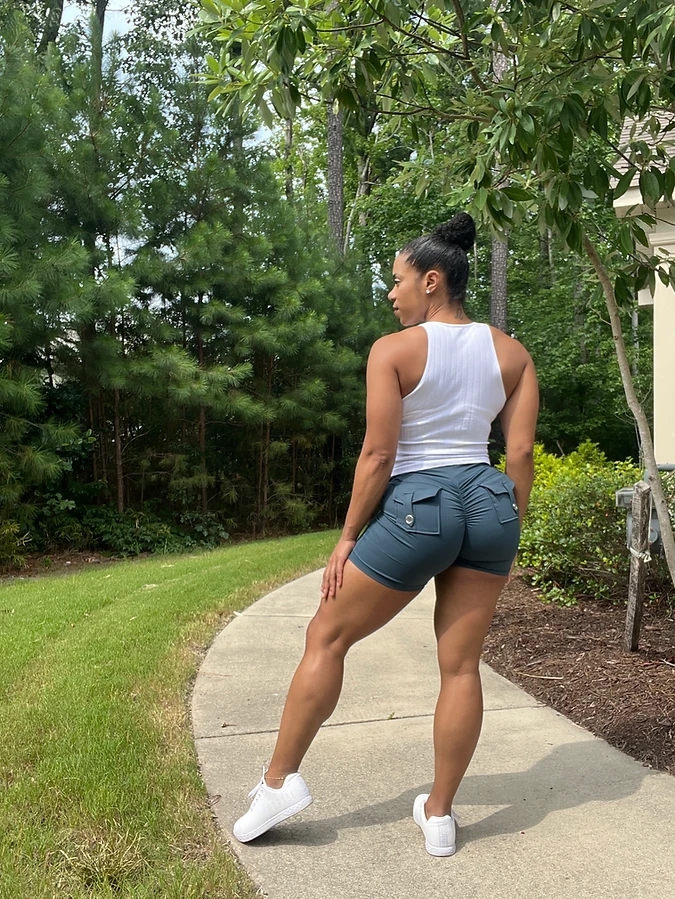
Thick is not a problem. Thick is the shape. It is the exact thing you described when you said you wanted thighs with real dimension and glutes that carry the silhouette. You cannot want that shape and flinch at the word for it.
Muscular is not unfeminine. Somewhere along the way you picked up the idea that muscle is masculine and softness is what makes you a woman, and that idea has cost more women more years than any bad program ever did. Muscle is not male, muscle is human. It is the tissue that lets you carry your own groceries at seventy, and it is the same tissue that gives your body its shape. There is nothing feminine about being weak. That was never true.
Femininity is not a body type. It is energy, confidence, power, nurturing, being open. One woman feels most herself with a lot of muscle on her. Another does not want much at all, and that is perfectly fine. The point is that the definition belongs to you.
So when somebody tells you that you are getting big, hear it correctly. That is not a warning. That is a progress report.
How long does it actually take to build the shape?
Years. Not weeks, not a challenge. A real build runs months at a time, and the body you are picturing is several of those back to back with refining phases in between.
You will feel it around week six or eight. You will see it around week twelve. Other people notice after that. That timeline does not negotiate with you.
Which means the single biggest predictor of whether you get this body is not your genetics and it is not your program. It is whether you stop starting over. Think about how many times you have begun. New program in January. Something different in March when that one stopped feeling exciting. A new approach in the fall. Every one of those was six or eight weeks in, right at the edge of where it was about to start working, and you moved.
And I do not think that makes you inconsistent. I think you were trained to expect it faster than it happens.
Think about what taught you what progress is supposed to look like. The thirty day challenge. The six week shred. The before and after photo taken on day thirty. Every one of those set a speed in your head, and that speed became your definition of working.
Then you carry it into real training. So at week six you look in the mirror, you hold what you see against a thirty day before and after, and your own head tells you this one is not working either. It is working. You are comparing week six of a real build to day thirty of a challenge, and those are not the same thing.
That is the exact moment most women leave. Week six, week eight, nothing visibly different yet, and something says this is not it. So you go find something else, and the new thing feels exciting, and the excitement feels like progress. It is not progress. It is newness. And then you are at week six again.
Nothing was wrong with those programs at week six. Week six is what week six looks like.
So the fix is not more discipline. You have discipline, you have been doing this for years. The fix is changing what you expect to see and when, because if thirty days is the number in your head, every real program you ever start is going to fail that test.
If you had stayed on any single one of them for two years, you would look different right now.
What building a body actually costs
Not money. Boundaries.
A lot of women are people pleasers, and that is exactly why training, nutrition, and health keep sliding to the bottom of the list. Building a body requires saying no to other people, and that is a logistics problem, not a personality flaw. It means not going out late the night before a session, or going out and not drinking. It means telling someone you love that you cannot, because you are going to the gym.
It also means asking for help, which for a lot of us is the harder half.
And it is an identity shift. You have to lock into a routine, shift things around in your life, and get a little uncomfortable being a slightly different person. The reason most people do not reach the goal is not the program. It is that they are not ready to sit in that discomfort.
What you get, which is the part that keeps you there
A built body changes how you move through a room. You have felt this from the other side. A woman walks in and something shifts before she says a word.
Underneath how it looks, there is capacity. Muscle is metabolically active tissue, so a body with real muscle on it recovers faster, holds up under a longer day, handles stress better, and does not run out on you at four in the afternoon. And on the metabolism question: your metabolism does not simply slow with age, you lose muscle as you age, and when you lose muscle you lose metabolism. Stay in the gym and that is not your problem to have.
Your work runs on that. Your kids run on that. Your patience runs on that.
And you are allowed to want it because of how it looks. You do not have to dress it up as health to make it acceptable to anybody. Health is the floor, not the ceiling.
FAQ
The next step
All of this only matters if the training is doing what you think it is doing, because you can decide to build and still get nothing if the tension is not going where you think it is.
I put the four most common versions of that into a free tutorial: The 4 Training Mistakes Killing Your Teardrop Hourglass. Why you cannot feel your reverse lunges in your glutes. Why loading your hip thrust heavier is not building them. The muscle group you are skipping that builds width in your thighs. And why your hamstrings are not growing.
It is short and it is free. gettheteardropmethod.com
And when you want the numbers built around your body instead of a guess, that is the Physique Design Diagnostic. We look at your training, your nutrition, your recovery, and your goals, find your primary bottlenecks, and build you a personalized 4-week execution map. $99, and you walk out with a plan you can execute immediately.
LaToya L. Price, MSN, APRN, FNP-BC. Board-Certified Nurse Practitioner and Certified Physique Coach.
Get the Free Tutorial.
Strategy. Precision. Level 2. Delivered to your inbox.