Is Body Shape Genetic? What Your Frame Influences and What You Build
Is body shape genetic? Partly. And the part that is genetic is a lot smaller than gym influencers make it sound.
I've been lifting for eight years. I'm a nurse practitioner, a physique coach, and I compete in wellness. So I'm not going to stand here and tell you genetics doesn't matter, because it does. What I'm going to tell you is exactly what it influences and what it doesn't, because once you can see that line clearly, you stop wasting years fighting the wrong thing.
This post is the written version of the new episode of Body, Presence, and Power.
What does genetics actually influence about your body?
The whole thing in two sentences. What you can change is muscle and fat. What you can't change is your bone structure and your muscle insertions.
That's the line. Everything else sits on one side of it or the other.
Your bone structure. The width of your hips, the width of your shoulders, the length of your torso. You cannot change that. So you build on top of it. Muscle through the glutes and quads changes your proportions without touching a single bone.
Your muscle insertions. That's where your muscle attaches to the bone, and it affects how a muscle looks once it's developed. You can't move the attachment. You can change how much muscle is sitting on it, and that's the part that actually changes what you see in the mirror.
How fast you grow and how fast you recover. Women have different hormonal environments and it shows up in the gym. One woman trains hard, recovers by the next session and does it again. Another woman runs the exact same program and gets buried by it. That's not her being weak or lazy. That's her recovery capacity, and it's a programming variable, not a character flaw. If you're not recovering, that's your cue to drop the frequency, not push harder. For a lot of women that means training a muscle group twice a week instead of three times and putting the intensity into the sessions you keep. Muscle grows between sessions, not during them.
I learned that one personally. I ran a program once that had me training glutes three times a week and my recovery was trash. Sore between sessions, heavy and tight all the time, and my massage therapist kept telling me how beat up I was. Some women can run that. I am not one of them.
Your ceiling. There's a cap on how big you can build a muscle, and it gets harder the more advanced you are. So you take the growth while it's cheap, because it never costs you less than it does right now. Some muscles barely move for some people (calves are the classic one). Give that muscle its own dedicated work, and if it still won't budge, put your energy into the muscles that answer you.
So genetics changes your rate, your recovery, and your ceiling. What it does not change is your direction. Every woman reading this can add muscle and every woman reading this can lose fat, and that's the entire toolkit you need to change your shape.
Can you change your body shape if you have a thick waist or a short torso?
Yes, but let me be specific, because vague encouragement is useless. If you naturally carry a thicker waist or you have a shorter torso, a tight waist is harder for you. Not impossible. Harder. A taller woman with a longer torso has an easier time with the same look. That's structure and I'm not going to pretend otherwise.
So you build what sits above it and below it. Lats and shoulders on top. Glutes and quads underneath. Your waist gets smaller by contrast without you doing one single thing to your waist. How much you build up top is your call: some women want the sculpted version, some want to stay slimmer up there and let the lower body lead. Either one works.
And train one side at a time, because all of us have a stronger side and a weaker side. Bulgarian split squats, single leg hip thrusts, single leg press, B-stance RDLs, single arm rows. The rule: start the set with your weak side. However many reps she gives you, that's the number. Match it on the strong side and stop. If you always start strong and go to failure, you spend the whole program making the gap bigger.
Is the hourglass or teardrop shape only for certain body types?
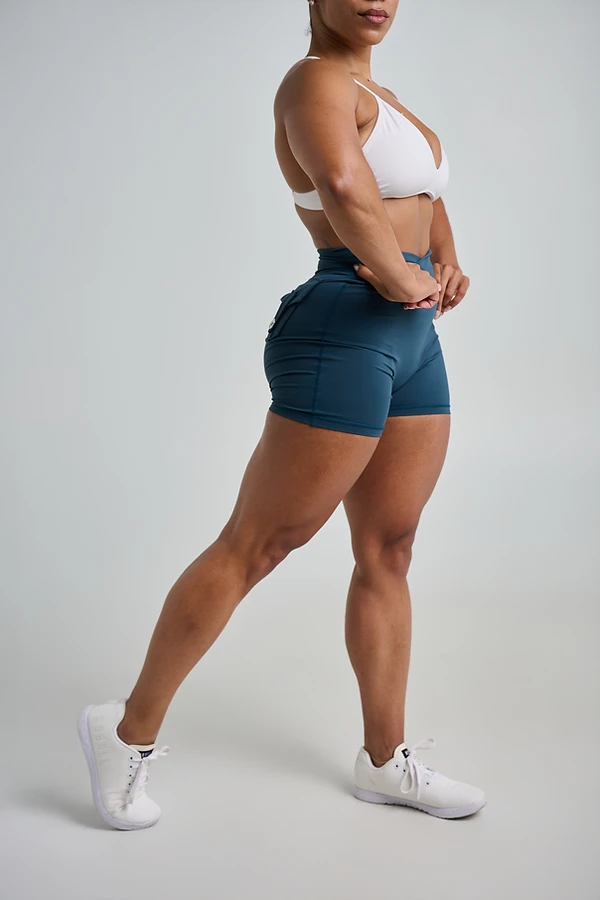
No. I see narrow-hipped women compete in wellness all the time. Women who look straight up and down from the front. They build glutes, quads, hamstrings, calves, real density through the lower body, and from the side they have the S-curve. It's there. It's built.
The shape is not a template you either match or you don't. It's a set of proportions, and you build toward it. The Teardrop Hourglass™ is hips wider than the shoulders, a tight waist, and a dense lower body all the way down that leads without overpowering the upper body. How that looks on your frame is going to be different from how it looks on mine, and that's not you falling short. That's what it looks like on you.
Look at any wellness lineup. Every woman up there qualified, and they don't look alike. Different heights, different torsos, different structures. The judges are deciding which physique is most pleasing to them, which is subjective. But you're not on a stage. Nobody is scoring you. You get to decide what pleasing looks like on your own frame.
Why isn't my body changing if I'm working out consistently?
If muscle and fat are both under your control, why are so many women putting in the work and not moving? Most of the time it comes down to what the program was actually built for.
A lot of programs were never designed for aesthetics. They're weight loss by any means necessary, so shape was never the goal and shape isn't what you get. The ones aimed at a look are usually aimed at a template, like an hourglass program built for an hourglass frame. If that's not your shape, or your weak points sit somewhere else, it's only going to take you so far.
Two women can want the exact same shape and need completely different programming, because what's lagging on one isn't what's lagging on the other. One needs her glute medius brought up. The other already has glutes and needs hamstrings and calves. Same goal, different work. So when somebody says it's genetics, what's usually true is that she's been running a program that was never pointed at her outcome, and genetics got blamed for a programming problem.
Can you build muscle and lose fat at the same time?
Sometimes, and it's capped. If you're brand new to lifting or carrying a lot of body fat, you can build some muscle while losing fat. People call it newbie gains and it's real. But it happens early, it doesn't last, and the deficit still limits it. If you've been training a few years, that window is closed. You're not building a lower body on a cut.
So you finish the diet smaller, with the same shape you started with. You get smaller. You don't get different.
The fix is the order. You build first, at maintenance or a slight surplus, running something pointed at whatever's actually lagging on you. You put the tissue on. Then you diet it down and reveal what you built. It's what I did and it's what every competitor does. It's also the part most women don't want to hear, because building means the scale isn't going down for a while.
So is it genetics or not?
Genetics plays a role. It absolutely does. But blaming all of it on genetics is, for me, partly an excuse. I'm naturally an hourglass. My family is hourglass, teardrop, pear, all lower body dominant. Even when I was smaller I had thick thighs and glutes without doing anything for them. But most of it was fat. What I built was muscle density, and that's a completely different thing. Nobody in my family has the lower body I have today, not because the genetics aren't there, but because they didn't train for it. The starting point was handed to me. The density was not.
You can build the shape you want. It takes strategy: nutrition that's built for building and programming that's pointed at your body and your weak points. What you control is execution. How well you train, how well you eat for it, how well you recover. That's the whole list, and it's enough.
FAQ
Where to start
If you want the training side of this laid out, grab my free tutorial, The 4 Training Mistakes Killing Your Teardrop Hourglass, at gettheteardropmethod.com. It's free and it goes straight to your inbox.
And if you want to know exactly what your frame is working with and where your programming is pointed wrong, that's what the Physique Design Diagnostic is for. $99, and you leave with a four-week execution map built for your body.
The episode is me actually talking, which means the stories make it in. Watch it here.
LaToya L. Price, MSN, APRN, FNP-BC. Board-Certified Nurse Practitioner and Certified Physique Coach.
Get the Free Tutorial.
Strategy. Precision. Level 2. Delivered to your inbox.